The Psychology of QR Codes at Events: Why Some Get Scanned and Others Get Ignored
Not all QR codes at events get scanned. Understanding the psychology behind what makes guests stop, scan, and participate can transform your photo collection results.
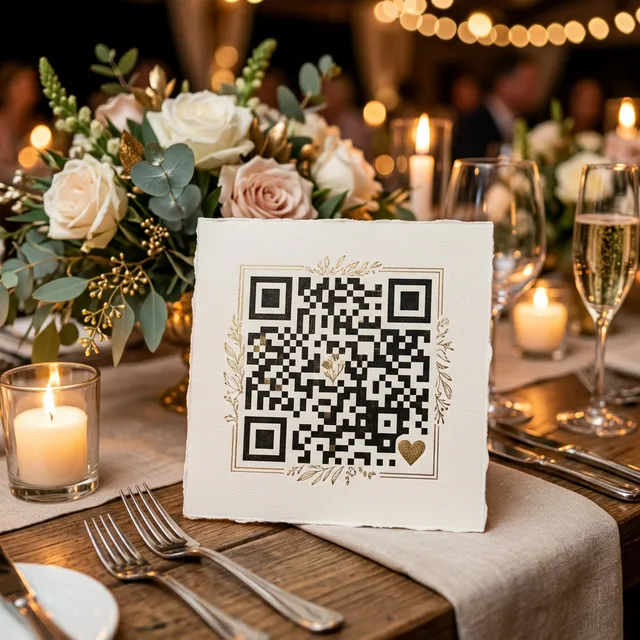
The Attention Filter: Why Most QR Codes Are Invisible
Human attention is selective. We constantly filter out stimuli that don't signal immediate relevance or reward. A small black-and-white QR code on a plain white piece of paper at a crowded event triggers no signal. The brain classifies it as "informational noise" and moves on.
For your QR code to cut through the filter, it needs to trigger one of three psychological responses:
- Curiosity — "What is this?"
- Social proof — "Others are doing this"
- Belonging — "This is for me, personally"
Each of these can be deliberately designed into your QR code presentation.
Designing for Curiosity
The QR code itself reveals nothing. What surrounds it does the work. Instead of a plain printout, consider:
- A decorative frame that matches your event aesthetic (floral for weddings, geometric for corporate)
- A headline above it that creates intrigue: "Your photo could be the memory of the night →"
- A subtle animation on a digital screen (a slow pulse around the QR code draws the eye)
The goal is to make the guest think "what happens when I scan this?" — and make the answer feel worth finding out.
Designing for Social Proof
When guests see others scanning and participating, the behavior normalizes. This is why the timing and placement of your QR code matters as much as the design.
Place your QR code where natural clusters form: near the bar, at the food station, at the entrance. These are the spots where guests pause, look around, and observe others. A guest who sees two or three people scanning at the bar will be far more likely to scan themselves than one who sees a code alone on a distant wall.
Designing for Belonging
Generic QR codes feel like marketing. Personal invitations feel like care.
The difference is in the language. Compare:
❌ "Scan to upload photos"
✅ "Priya & Rahul want to see your photos from tonight ❤️ Scan to share"
The second version names the couple, acknowledges the guest's presence, and frames the action as a gift — not a task. The psychology shifts from obligation to participation.
The Optimal QR Code Placement Stack
Combining placement strategy with psychological design:
- Table card: Belonging, Curiosity
- Bar / food station: Social proof, Curiosity
- Entrance backdrop: Curiosity, Belonging
- AV screen during break: Social proof, Social proof
- Return gift bag card: Belonging, Curiosity
Use at least three of these simultaneously. Redundancy isn't waste — it's how you reach the different personality types in your guest list.
The Timing Layer
Scanning behavior follows event energy. The highest scan rates happen: during cocktail hour, immediately after a high-emotion moment, or when the event briefly pauses.
Ask your emcee or MC to mention the QR code at these moments specifically. A verbal cue during a natural pause dramatically increases scan rates — because it provides a goal for the downtime.
Conclusion
The best QR code at your event isn't the one with the most sophisticated design. It's the one placed where your guests already are, framed with language that makes them feel invited rather than instructed, and supported by a social environment where others are already participating.
Design for the human. The scan will follow.